

Central air conditioners in 2026 split into five efficiency tiers, and SEER2 rating is the number that separates them. Variable-speed central air conditioners rated 19 to 26 SEER2 win overall, two-stage units at 16 to 18 SEER2 win on balanced upgrades, and single-stage systems at the federal minimum of 13.4 SEER2 win on straight budget.
- Variable-speed central AC rated 19-26 SEER2 is the best overall pick for 2026 whole-home comfort.
- Two-stage AC at 16-18 SEER2 balances upfront cost against real efficiency gains.
- Single-stage AC at 13.4 SEER2 meets the federal minimum and fits rental or short-hold properties.
- Ductless mini-splits publish SEER2 ratings into the low 30s for zoned garages and workshops.
- Packaged rooftop units run 14-16 SEER2, the tradeoff for skipping indoor duct space.
Why this matters
SEER2 replaced SEER in January 2023 under a Department of Energy test that adds real duct static pressure to the measurement, so a SEER2 number runs lower than the old SEER label on the same equipment. Minnesota and the rest of the North DOE region carry a 13.4 SEER2 minimum for split-system central air, while the South and Southwest regions sit at 14.3 SEER2. If you're comparing options for a Minnesota home, the central air conditioners for Minnesota summers guide covers sizing alongside the rating tiers below.
A higher SEER2 rating means lower electricity draw per ton of cooling, but it also usually means a bigger equipment cost and, on variable-speed systems, a communicating thermostat requirement. Ranking by SEER2 rating alone without weighing stage type and ductwork fit gets buyers into equipment that never runs at its rated efficiency.
What makes the best air conditioner by SEER2 rating
- Verified SEER2 rating tested under the current DOE M1 procedure, not a leftover SEER number
- Stage type — single-stage, two-stage, or variable-speed — since this drives both efficiency and comfort more than the SEER2 number alone
- Compressor and sound rating, because variable-speed compressors run quieter across their operating range
- Ductwork compatibility — a high-SEER2 system pushed through undersized ducts underperforms its rating
- Regional minimum compliance — North vs. South DOE zones set a different SEER2 floor
- Thermostat pairing, since communicating variable-speed systems need a matched control to hit their rated SEER2
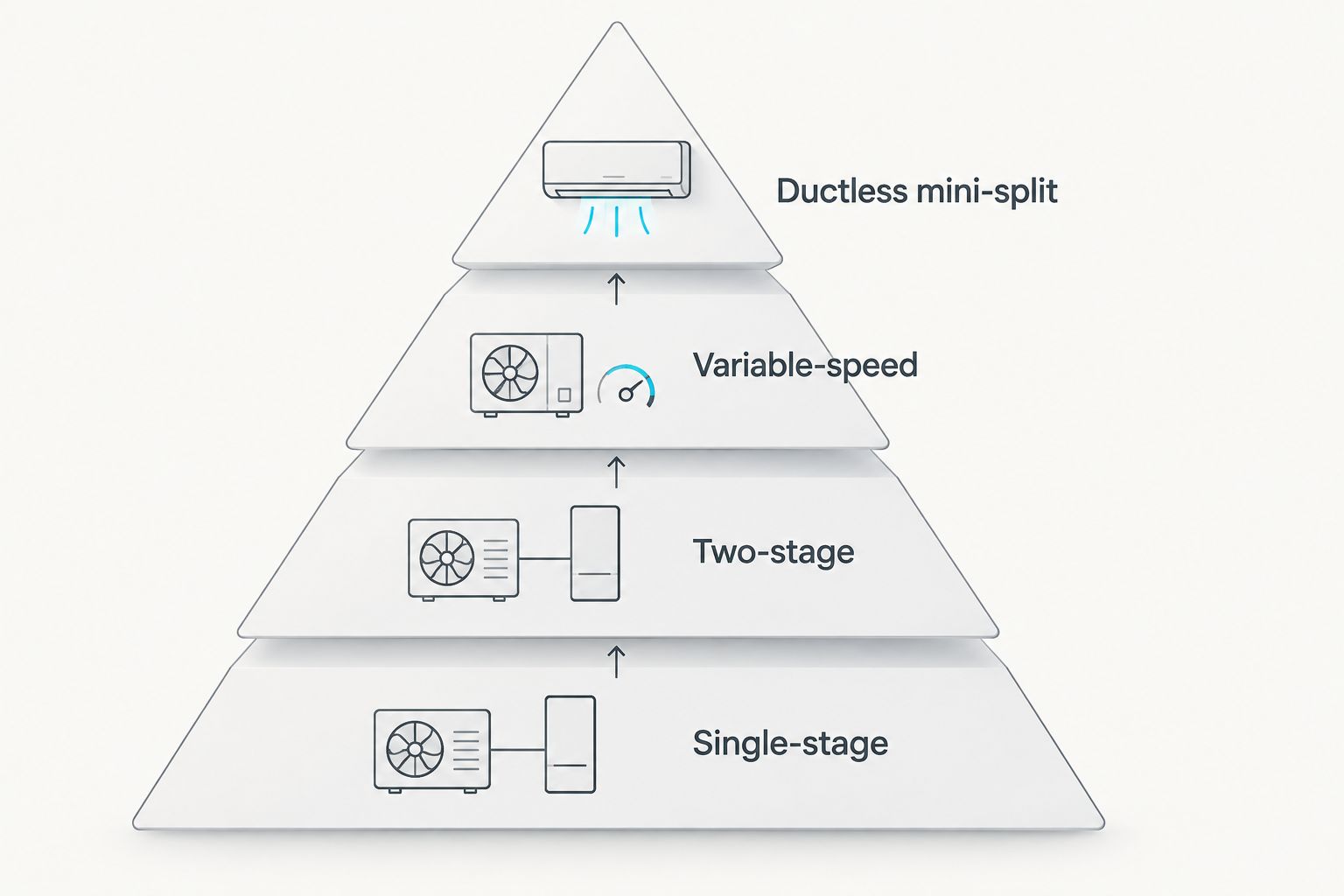
Air conditioners ranked by SEER2 rating: at a glance
| Type | SEER2 range | Best for | Key limitation |
|---|---|---|---|
| Variable-speed central AC | 19-26 SEER2 | Whole-home comfort, lowest operating cost | Needs a matched communicating thermostat |
| Two-stage central AC | 16-18 SEER2 | Balanced upgrade for moderate climates | Less humidity control than variable-speed |
| Single-stage central AC | 13.4-15.2 SEER2 | Budget replacements, rental properties | Cycles on/off at full capacity only |
| Ductless mini-split | Up to low-30s SEER2 | Garages, workshops, room additions | No central ductwork, one zone per head |
| Packaged rooftop unit | 14-16 SEER2 | Homes without basement or attic space | Outdoor exposure limits efficiency gains |
1. Variable-speed central AC: best overall for whole-home comfort
A variable-speed central air conditioner modulates compressor output instead of switching between fully on and fully off, which is why the top units publish SEER2 ratings between 19 and 26. That modulation also runs longer, gentler cycles that pull more moisture out of the air per hour than a single-stage system.
Variable-speed AC pros:
- Highest published SEER2 ratings on the market for 2026
- Quieter operation across the full range of outdoor temperatures
- Better humidity control from longer, lower-capacity run cycles
Variable-speed AC cons:
- Requires a compatible communicating thermostat to hit the rated SEER2
- More expensive to service since diagnostics need matched controls
- Overkill for a home you plan to sell within a year or two
Best for: owners planning to stay put and wanting the lowest year-round electric bill. Verdict: Buy if you're keeping the house past 2026.
2. Two-stage central AC: best for a balanced upgrade
Two-stage systems run at roughly 60-70% capacity most of the time and kick to full capacity only on the hottest days, landing them in the 16-18 SEER2 range. That's the tier most contractors install when a customer wants a real efficiency step up without paying for full variable-speed hardware.
Two-stage AC pros:
- Meaningful jump over single-stage without the top-tier price
- Handles moderate humidity swings better than single-stage
- Standard thermostats usually work without a communicating upgrade
Two-stage AC cons:
- Still cycles fully off between calls for cooling, unlike variable-speed
- SEER2 rating tops out well below the best variable-speed units
Best for: a moderate-climate home replacing aging equipment on a normal timeline. Verdict: Buy if variable-speed pricing doesn't pencil out for your square footage.
3. Single-stage central AC: best budget option
Single-stage air conditioners run at one capacity, full blast, until the thermostat is satisfied, which puts them right at the federal floor of 13.4 to 15.2 SEER2. It's the tier that meets code and nothing more.
Single-stage AC pros:
- Lowest equipment cost of the three central AC stage types
- Simple compressor design means fewer parts to fail
- Meets DOE minimum SEER2 rating for the North region without exception
Single-stage AC cons:
- No humidity or comfort advantage over the code minimum
- Full-blast cycling means bigger temperature swings between cycles
- Least room to improve efficiency without full equipment replacement
Best for: rental properties, short-hold homes, or a strict budget replacement. Verdict: Hold unless the current unit failed outright.
4. Ductless mini-split: best for garages and zoned spaces
Ductless mini-splits skip central ductwork entirely, and single-zone models publish SEER2 ratings that run into the low 30s — higher than any ducted central system on this list. That efficiency comes from a compressor and indoor head matched as one sealed system with no duct losses.
Ductless mini-split pros:
- Highest SEER2 ratings available for any single-zone AC type
- No ductwork required, which fits garages, workshops, and additions
- Independent zone control room by room
Ductless mini-split cons:
- Covers one zone per indoor head, not a whole house
- Indoor unit is visible on the wall or ceiling of the room
A full breakdown of unit sizing and placement for outbuildings is in the ductless mini-splits for garages and workshops guide. Best for: a detached garage, finished basement, or workshop with no existing ducts. Verdict: Buy for any zone central air doesn't reach.
5. Packaged rooftop unit: best for homes without duct space
Packaged units combine the compressor, coil, and blower into one outdoor cabinet, which is why they typically land at 14-16 SEER2 — the outdoor-exposed compressor loses some of the efficiency edge a split system's indoor coil keeps.
Packaged unit pros:
- No indoor equipment footprint since everything sits outside
- Common fit for condos, manufactured homes, and additions without basements
Packaged unit cons:
- SEER2 rating trails split systems in the same price tier
- Outdoor exposure means more weather-related wear over time
Best for: a home with no basement or attic space for a split system's indoor coil. Verdict: Hold unless a split system genuinely won't fit.
How we ranked these
The ranking runs on published SEER2 rating ranges by stage type first, then on which use case each tier actually serves — a variable-speed system winning "best overall" doesn't make a single-stage unit wrong for a rental property. Sound rating, thermostat compatibility, and regional DOE minimums broke ties between tiers with overlapping SEER2 ranges. None of these tiers perform to their rated SEER2 without maintenance on schedule — the HVAC maintenance plans compared page lays out what keeps a system at its rated efficiency past year one.
Which air conditioner should you choose for 2026?
If you're staying in the house and want the lowest bill, buy the variable-speed system rated 19-26 SEER2. If the budget caps out before that, the two-stage tier at 16-18 SEER2 is the honest middle ground for 2026. Anyone cooling a garage, workshop, or single room without ducts should skip central air entirely and go ductless.
Get a SEER2 efficiency assessment
A technician can match your home’s ductwork to the right SEER2 tier before you buy.
FAQ
What is a good SEER2 rating for an air conditioner in 2026?
A SEER2 rating of 16 or higher is a good efficiency target for 2026, with variable-speed systems reaching 19 to 26 SEER2. Anything at the 13.4 SEER2 floor only meets the federal minimum, it isn’t a comfort or efficiency upgrade.
Is SEER2 the same as SEER?
No, SEER2 replaced SEER as the official testing standard starting in January 2023. SEER2 uses higher duct static pressure in testing, so a SEER2 number typically reads a few points lower than the old SEER rating on identical equipment.
What’s the minimum SEER2 rating allowed by law?
The federal minimum is 13.4 SEER2 for split-system central AC in the North DOE region and 14.3 SEER2 in the South and Southwest regions. Minnesota falls in the North region, so 13.4 SEER2 is the compliance floor.
Do variable-speed air conditioners really save money over single-stage models?
Yes, variable-speed systems rated 19-26 SEER2 use less electricity per ton of cooling than single-stage units at 13.4-15.2 SEER2 because they modulate output instead of cycling fully on and off. The savings show up most in homes that run cooling for long stretches of the season.
What SEER2 rating do ductless mini-splits reach?
Single-zone ductless mini-splits publish SEER2 ratings into the low 30s, higher than any ducted central system. That efficiency comes from a sealed compressor-to-head match with no duct losses.
How much higher is a two-stage AC’s SEER2 rating than a single-stage unit?
Two-stage systems typically run 16-18 SEER2 versus 13.4-15.2 SEER2 for single-stage units, a gap of roughly 2 to 4 SEER2 points. That gap reflects the two-stage compressor’s lower-capacity run mode for most of the cooling season.
Does a higher SEER2 rating matter in a cold climate like Minnesota?
Yes, but the payback period runs longer than in hot climates since the cooling season is shorter. A variable-speed system still earns its SEER2 rating during Minnesota’s peak summer months, it just accumulates savings over fewer months per year.
Can I upgrade an existing central AC to a higher SEER2 rating without changing ductwork?
Sometimes, but undersized or leaky ductwork caps the real-world efficiency a high-SEER2 unit can deliver regardless of its rating. A duct evaluation before the swap is the only way to confirm the new unit will hit its published SEER2 number.
One last thing
A SEER2 rating on a spec sheet assumes clean ductwork, correct refrigerant charge, and a thermostat that's actually matched to the equipment — skip any one of those and a 22 SEER2 unit can perform closer to a 15 SEER2 unit in daily use. Pairing a variable-speed system with a compatible control matters as much as the rating itself; the smart thermostats for cold climates guide covers which controls actually communicate with variable-speed compressors.
Related guides

