

Best overall for a garage in 2026: Mitsubishi MSZ-FS Hyper-Heating H2i. Best for a precharged installation path: MRCOOL DIY 4th Generation. Best for occasional use: Senville LETO Series. Best for an attached garage: Fujitsu AIRSTAGE H-Series. Best for a divided workshop: Pioneer Diamante Multi-Zone. This guide compares where each system fits and what can rule it out.
- The best mini split for garage use in 2026 is Mitsubishi MSZ-FS Hyper-Heating H2i for severe winter cold.
- MRCOOL DIY 4th Generation is best for owners prioritizing a precharged installation path.
- Senville LETO Series fits insulated garages used occasionally rather than as full-time winter workspaces.
- Fujitsu AIRSTAGE H-Series suits attached garages where indoor and outdoor unit placement affects household noise.
- Pioneer Diamante Multi-Zone fits workshops with separate areas needing independent temperature control.
Why this matters
A garage loses heat differently from a finished room. Overhead doors, concrete slabs, air leakage and limited wall insulation can overwhelm equipment selected from square footage alone. Cold-climate performance matters more than the largest advertised capacity.
Garage heating also affects the rest of your HVAC plan. If the house needs primary heating equipment as well, compare the garage options below with this guide to the best furnaces for Minnesota winters.
The Schwantes Heating garage mini split guide ranks five equipment families by operating fit. Manufacturer specifications available for this 2026 comparison supply the temperature and capacity details; the final size still requires a room-by-room load calculation.
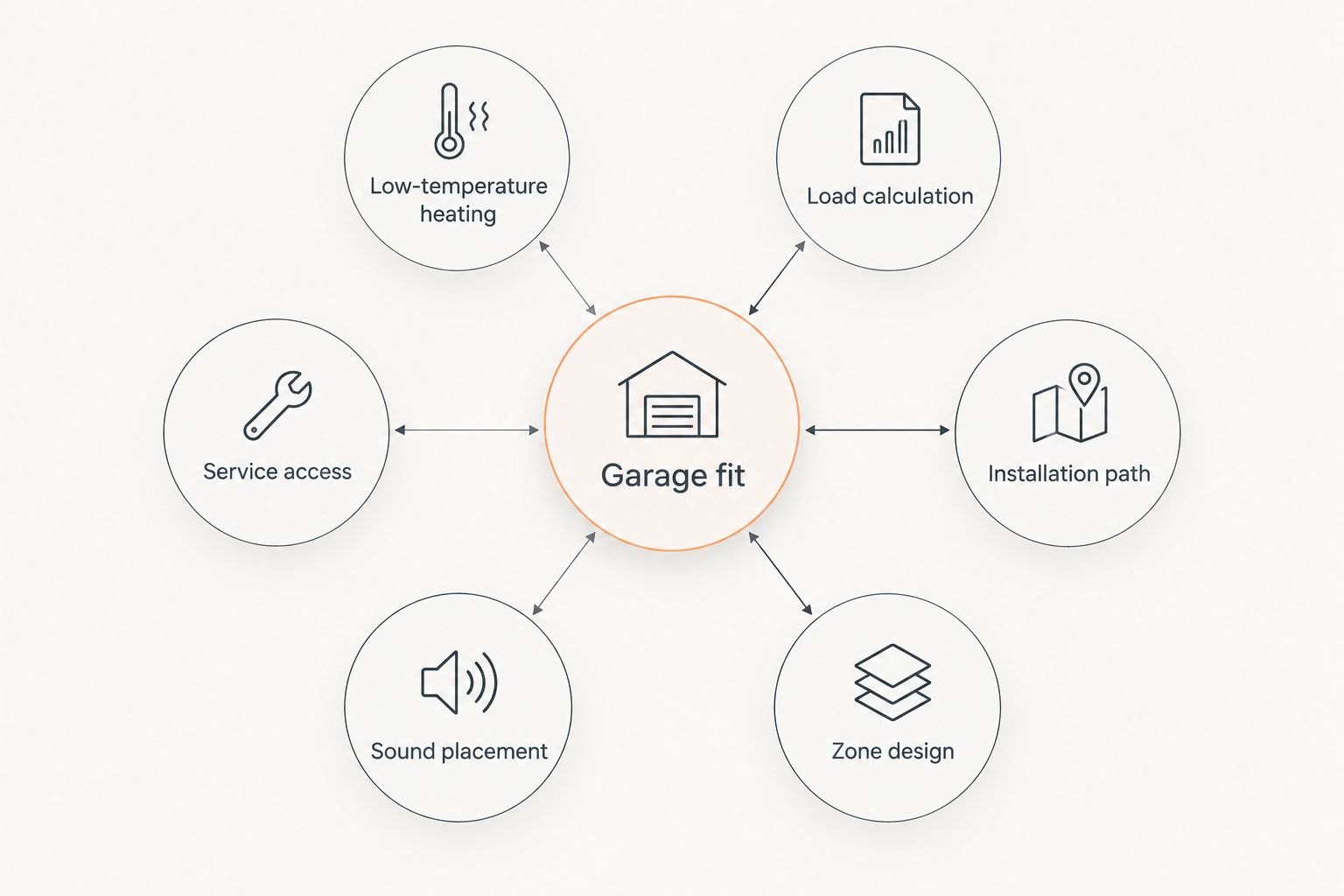
What makes the best mini split for a garage
- Low-temperature heating: Check how capacity changes as outdoor temperatures fall, not only the minimum operating temperature.
- Load calculation: Include insulation, ceiling height, overhead-door construction, windows, air leakage and local design temperature.
- Installation path: Separate precharged DIY-oriented systems from equipment requiring field refrigerant work.
- Zone design: Use one zone for an open garage and consider multiple zones only for genuinely divided work areas.
- Sound placement: Keep indoor airflow away from benches while locating the outdoor unit away from bedrooms and doors.
- Service access: Leave room to clean filters, clear snow, inspect the drain and reach the outdoor coil.
Garage mini splits at a glance
| Model | Best for | Standout feature | Key limitation |
|---|---|---|---|
| Mitsubishi MSZ-FS Hyper-Heating H2i | Garages in severe winter cold | Published low-temperature heating operation | Professional design and installation are the practical route |
| MRCOOL DIY 4th Generation | Precharged installation projects | Factory-charged line-set approach | Fixed line-set choices constrain placement |
| Senville LETO Series | Insulated, occasional-use garages | Straightforward single-zone format | Published heating range is less suited to severe cold |
| Fujitsu AIRSTAGE H-Series | Attached garages | Broad modulation and placement options | Exact performance varies by matched indoor and outdoor units |
| Pioneer Diamante Multi-Zone | Divided workshops | Multiple indoor zones from one outdoor system | More complicated sizing and refrigerant routing |
1. Mitsubishi MSZ-FS Hyper-Heating H2i: best for severe cold
Mitsubishi MSZ-FS systems pair wall-mounted indoor units with Hyper-Heating H2i outdoor equipment. Mitsubishi publishes heating operation down to -13°F for applicable combinations, making this family the strongest default when a detached garage must remain usable during prolonged cold.
The MSZ-FS family includes nominal capacity classes such as 6,000 BTU/h, 9,000 BTU/h, 12,000 BTU/h, 15,000 BTU/h and 18,000 BTU/h. Those labels are not a substitute for design-temperature output: the correct selection depends on the matched outdoor unit and the garage load.
Mitsubishi MSZ-FS Hyper-Heating H2i pros:
- Published performance data covers low outdoor temperatures.
- Several nominal capacities support small and midsize garage layouts.
- Variable-speed operation can reduce temperature swings after the space reaches its setpoint.
Mitsubishi MSZ-FS Hyper-Heating H2i cons:
- Equipment selection depends on an approved indoor-outdoor pairing.
- Refrigerant, electrical and condensate work make professional installation the practical choice.
- A cold-climate system cannot compensate for major air leakage indefinitely.
Best for: A detached garage or daily workshop where winter heating is the first priority.
Verdict: Buy after a load calculation confirms the matched system maintains enough capacity at the local design temperature.
2. MRCOOL DIY 4th Generation: best precharged installation path
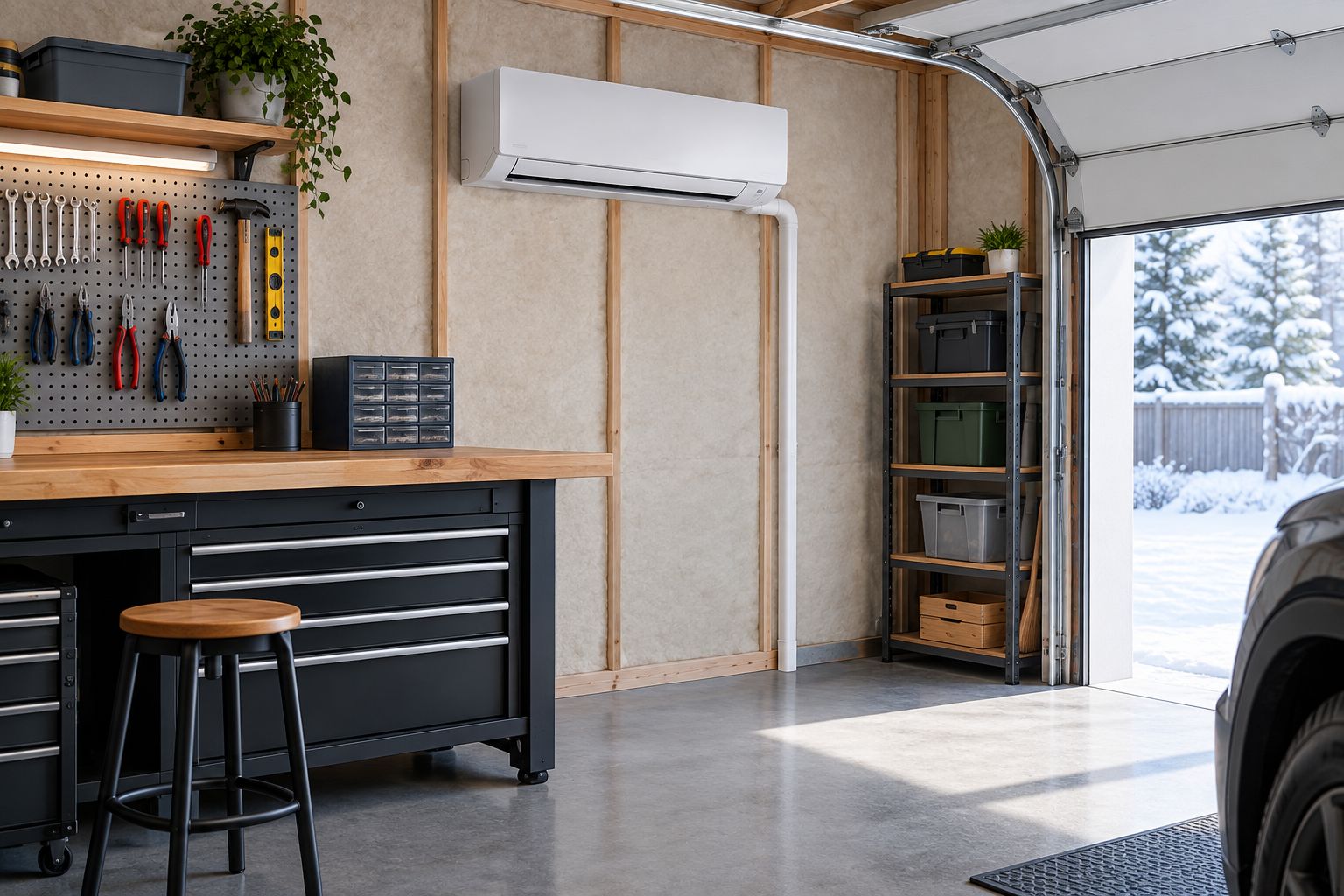
MRCOOL DIY 4th Generation systems use factory-precharged line sets and sealed connections designed to avoid field evacuation and refrigerant charging when installed exactly as directed. That changes the refrigerant-work portion of the project, but it does not remove electrical-code, permit or mounting requirements.
Common configurations include nominal 12,000 BTU/h, 18,000 BTU/h, 24,000 BTU/h and 36,000 BTU/h classes. Match the specific system rather than assuming a larger label fixes poor insulation or an oversized overhead door.
MRCOOL DIY 4th Generation pros:
- Precharged connections simplify the refrigerant side of installation.
- Several nominal capacities cover common residential garage sizes.
- The system provides both heating and cooling from one indoor head.
MRCOOL DIY 4th Generation cons:
- Available line-set lengths affect where both units can be mounted.
- Excess line cannot be cut and re-flared like a conventional field-installed line set.
- Local rules can still require permits or licensed electrical work.
Best for: A capable homeowner whose garage layout matches an approved precharged configuration.
Verdict: Buy only when the line route, electrical supply and winter performance all fit the published installation requirements.
3. Senville LETO Series: best for occasional garage use
Senville LETO is a single-zone heat-pump family intended to provide heating, cooling, dehumidification and fan operation. Senville publishes heating operation to approximately 5°F for LETO systems, which separates it from equipment designed around substantially colder winter conditions.
That operating figure is a boundary, not proof that the unit delivers its nominal output at 5°F. Use LETO where the garage is insulated, winter conditions are moderate or another safe heat source covers temperatures below the system's useful range.
Senville LETO Series pros:
- Single-zone design suits one open garage bay or workshop.
- Multiple operating modes cover seasonal heating and cooling.
- Common nominal capacities provide several sizing options.
Senville LETO Series cons:
- The published low-temperature range is a weak match for severe winter cold.
- Field-installed refrigerant lines require the correct tools and procedures.
- Nominal capacity does not show how much heat remains near the operating limit.
Best for: An insulated garage used intermittently in a climate where extreme cold is not the core design problem.
Verdict: Hold for cold regions; Buy only when local winter conditions and the calculated load fit the published performance range.
4. Fujitsu AIRSTAGE H-Series: best for attached garages
Fujitsu AIRSTAGE H-Series systems offer several indoor-unit and outdoor-unit combinations, giving an installer room to address wall space, airflow and outdoor placement. That flexibility matters when a garage shares walls or sleeping-area proximity with the house.
Do not select an H-Series system from the indoor-unit name alone. Heating output, operating range and efficiency belong to the complete matched combination, so both model numbers must appear in the proposal.
Fujitsu AIRSTAGE H-Series pros:
- Multiple matched combinations support different room layouts.
- Variable-speed operation adapts output as the garage approaches its setpoint.
- Flexible placement can keep supply air away from a fixed workbench.
Fujitsu AIRSTAGE H-Series cons:
- Performance cannot be judged from the indoor head alone.
- Professional commissioning is the practical installation route.
- Poor outdoor-unit placement can transmit sound or recirculate discharge air.
Best for: An attached garage where equipment location and sound transfer require careful planning.
Verdict: Buy when the proposal identifies the complete matched system and its cold-weather output.
5. Pioneer Diamante Multi-Zone: best for divided workshops
Pioneer Diamante Multi-Zone systems connect one outdoor unit to multiple indoor units. This arrangement fits a workshop divided into separate rooms better than a single head expected to move conditioned air through closed doors.
Multi-zone design introduces a new sizing problem: the outdoor unit must support the connected indoor units while each room receives enough capacity. Refrigerant routes, elevation limits and allowed indoor-unit combinations must follow the selected system's engineering data.
Pioneer Diamante Multi-Zone pros:
- Separate indoor units provide independent room control.
- One outdoor system can reduce the number of condensers around the building.
- Different zones can address enclosed work and storage areas.
Pioneer Diamante Multi-Zone cons:
- Installation is more involved than a single-zone garage system.
- A failure at the shared outdoor unit affects every connected zone.
- Open garages rarely benefit from extra heads placed in the same undivided space.
Best for: A detached workshop containing enclosed rooms with different schedules or temperature needs.
Verdict: Buy for truly separate rooms; Skip for one open garage where a correctly placed single zone can serve the entire space.
How we ranked the systems
This Schwantes Heating mini split comparison is a fit ranking, not a claim that every model was tested in one building. Low-temperature performance and load matching carried the most weight for 2026, followed by installation constraints, zoning, sound placement and service access.
Manufacturer literature supports the stated operating temperatures and nominal capacities. It does not reveal your garage's heat loss, so no model earns a recommendation without checking the building envelope and local winter design conditions.
Check your garage system options
Review Schwantes Heating before choosing equipment, capacity or an installation path.
Which garage mini split should you choose in 2026?
Schwantes Heating's 2026 verdict is Mitsubishi MSZ-FS Hyper-Heating H2i for a garage that needs dependable heating through severe winter cold. MRCOOL DIY 4th Generation is the better fit when a compatible precharged installation is the deciding factor. Senville LETO belongs in an insulated, occasional-use space with milder winter demands.
Choose Fujitsu AIRSTAGE H-Series when an attached garage requires careful unit placement. Choose Pioneer Diamante Multi-Zone only when walls and doors create separate zones; multiple heads do not fix poor airflow planning in one open room.
FAQ
What’s the best mini split for a garage in 2026?
Mitsubishi MSZ-FS Hyper-Heating H2i is the best overall fit for a garage facing severe winter cold in 2026. Its published low-temperature operation makes it a stronger starting point than systems intended for moderate conditions, but final sizing still requires a load calculation.
Is a mini split enough to heat an uninsulated garage?
A mini split can add heat to an uninsulated garage, but equipment selection alone does not solve rapid heat loss. Air sealing and insulation should be addressed before treating any nominal BTU rating as sufficient.
Is a 12,000 BTU mini split large enough for a garage?
A 12,000 BTU/h nominal system is large enough only when a load calculation says it is. Garage area, insulation, ceiling height, overhead doors, leakage and winter design temperature can change the required capacity substantially.
Can you install a garage mini split yourself?
A precharged system such as MRCOOL DIY 4th Generation is designed to simplify the refrigerant connection. Electrical work, permits, wall penetrations, drainage and mounting still have to meet manufacturer instructions and local requirements.
Do garage mini splits work below zero?
Some cold-climate mini splits operate below 0°F, while other systems stop sooner or lose too much capacity for the load. Mitsubishi publishes operation down to -13°F for applicable MSZ-FS Hyper-Heating combinations, but the matched system’s output table remains the deciding document.
Should a garage use one zone or multiple zones?
One open garage normally needs one correctly placed indoor zone. Multiple zones make sense when permanent walls and doors divide a workshop into rooms that need independent control.
Where should the indoor mini split unit go in a garage?
Place the indoor unit high on a clear wall where supply air can reach the occupied area without blowing directly across a fixed workstation. Preserve filter access and keep the unit away from vehicle impact, tall storage and grinding debris.
Does a garage mini split need backup heat?
Backup heat is appropriate when the selected mini split cannot cover the calculated load at the local winter design temperature. The decision should come from the equipment’s low-temperature capacity table, not its nominal rating.
One last thing
Minimum operating temperature and usable heating capacity are not the same specification. A system can continue running at a low temperature while producing less heat than the garage loses. For any 2026 proposal, ask for the matched system's heating output at local design temperature and compare that figure with the calculated garage load.
Related guides

