

Best overall: a MERV 13 pleated furnace filter that fits your existing slot and passes an airflow check. Best for a dedicated media cabinet: a deep-media MERV 13 filter. Best when MERV 13 restricts airflow: a MERV 11 pleated filter. The best furnace filters for allergies in 2026 balance particle capture with what your HVAC system can move air through safely.
- The best furnace filters for allergies in 2026 are MERV 13 pleated filters when the HVAC system supports them.
- Choose a deep-media MERV 13 filter for an existing media cabinet, not a standard filter slot.
- Use MERV 11 when an airflow check rules out MERV 13; MERV 8 is a basic fallback.
- Check the filter’s exact dimensions and airflow requirements before replacing it.
Why this matters
A furnace filter catches particles in air that passes through the HVAC system. For allergies, that makes filtration useful, but only while air is moving through a properly fitted filter. A higher rating is not an automatic upgrade if it strains airflow or leaves gaps around the frame.
Schwantes Heating's furnace-filter verdict for 2026 is MERV 13 for homes whose HVAC systems can support it, with MERV 11 as the fallback. The U.S. Environmental Protection Agency advises using a filter rated MERV 13 or as high as the system can accommodate. Before choosing one, check the filter size, the cabinet or slot, and the system's airflow requirements. Schwantes Heating is the starting point for its related heating and air-quality guides.
What makes the best furnace filter for allergies
Use these criteria before comparing ratings. They separate a useful allergy filter from one that looks better on the package but is wrong for the system.
- Particle-capture rating: MERV, or Minimum Efficiency Reporting Value, rates filter performance under ASHRAE's Standard 52.2. The test covers particles from 0.3 to 10 micrometers; a higher rating represents stronger capture within its tested particle-size ranges.
- Airflow compatibility: The filter must work within the HVAC system's airflow and pressure limits. Do not assume the highest MERV rating that physically fits is acceptable.
- Exact fit: Match the required filter dimensions and frame style. Air that slips around an undersized filter does not get filtered by its media.
- Cabinet compatibility: A deep-media filter needs a cabinet built for its depth. A standard slot and a media cabinet are different installation choices, not interchangeable filters.
- Replacement access: Choose a filter you can inspect and replace as directed by its manufacturer and the HVAC equipment instructions. A loaded filter changes the airflow decision.
Best furnace filters for allergies at a glance
The ranking assumes the filter fits the equipment and meets its airflow requirements. No MERV rating overrides those checks.
| Filter type | Best for | Standout feature | Key limitation |
|---|---|---|---|
| MERV 13 pleated, standard-slot | Existing standard slots | Stronger rated particle capture than MERV 11 | Requires an airflow check |
| MERV 13 deep-media | Existing media cabinets | MERV 13 filtration in a cabinet-specific format | Will not fit a standard slot |
| MERV 11 pleated | Systems that cannot support MERV 13 | Step up from MERV 8 | Lower rated capture than MERV 13 |
| MERV 8 pleated | Systems limited to MERV 8 | Basic filtration in a common format | Weakest allergy-focused choice here |
These are filter types, not interchangeable products. In 2026, start with the format your system accepts, then choose the highest suitable rating. If you do not know the system's limits, the table is a shortlist for evaluation, not permission to install a denser filter.
1. MERV 13 pleated: best furnace filter for an existing standard slot
Best for: A household with a standard filter slot and an HVAC system that supports a MERV 13 filter in that size and format.
A MERV 13 pleated filter is the default allergy pick because it offers a higher rated level of particle capture than MERV 11 or MERV 8. It also follows the EPA's advice to use MERV 13 when the system can accommodate it. For a standard slot, buy the exact dimensions the equipment requires; do not treat an almost-fitting frame as close enough.
The condition matters as much as the rating. Filter resistance varies by product, so the MERV label alone does not tell you whether a particular filter works with your blower, ductwork and filter opening. If the equipment documentation does not resolve the question, have airflow and pressure checked before making MERV 13 the permanent choice.
MERV 13 pleated pros:
- Higher rated particle capture than the lower-MERV options in this guide.
- Available as a standard-slot format without requiring a media cabinet.
- A clear first choice when system compatibility is confirmed.
MERV 13 pleated cons:
- Physical fit does not prove acceptable airflow.
- Product-to-product resistance differs despite the shared MERV rating.
- A poorly seated frame still allows air to bypass the filter.
Verdict: Buy a standard-slot MERV 13 pleated filter only after confirming its size and system compatibility. For Schwantes Heating readers comparing furnace filters for allergies in 2026, this is the default, not an instruction to ignore airflow limits.
2. MERV 13 deep-media: best for an existing media cabinet
Best for: A home that already has a compatible deep-media filter cabinet.
A deep-media MERV 13 filter pairs the preferred rating with a different physical format. It belongs in the cabinet specified for it, with the correct frame dimensions and installation direction. Its place in the ranking is about matching an existing setup; it is not a claim that every deep-media filter outperforms every standard-slot filter.
Do not push a deep filter into a standard slot or substitute a different cabinet size because the MERV number matches. The cabinet determines what fits, while the filter's specifications and equipment requirements determine whether the combination is appropriate. If you are considering a cabinet change, assess that as an HVAC equipment decision rather than a routine filter replacement.
MERV 13 deep-media pros:
- Provides the same MERV 13 rating target in a media-cabinet format.
- Gives existing media-cabinet owners a clear, like-for-like format to evaluate.
- Keeps the fit decision tied to the cabinet's specified filter dimensions.
MERV 13 deep-media cons:
- Does not fit an ordinary standard-depth slot.
- A matching MERV rating does not guarantee a match to the cabinet.
- Changing cabinet type is more involved than replacing a filter.
Verdict: Buy a deep-media MERV 13 filter when your existing cabinet and HVAC specifications call for that format. Skip it if you have only a standard slot.
3. MERV 11 pleated: best when MERV 13 restricts airflow
Best for: An HVAC system that can use MERV 11 but does not meet the requirements for the MERV 13 option being considered.
MERV 11 is the practical middle choice in this 2026 ranking. It has a higher rated capture level than MERV 8 without making MERV 13 the only acceptable answer for every system. That makes it a fallback after a compatibility check, not a reason to skip the check.
Compare filters in the correct size and format. A MERV 11 label cannot rescue a loose frame, and different filters with the same rating can present different resistance to airflow. If MERV 13 causes an airflow problem, identify the acceptable filter specification for the equipment rather than guessing that any MERV 11 product will solve it.
MERV 11 pleated pros:
- Higher rated capture than MERV 8.
- Offers a distinct fallback when MERV 13 is unsuitable.
- Can be selected in the format specified for the existing filter opening.
MERV 11 pleated cons:
- Lower rated particle capture than MERV 13.
- Still needs a size and airflow check.
- Cannot correct gaps around the filter frame.
Verdict: Buy MERV 11 when the equipment supports it and MERV 13 does not pass the airflow check. Hold on downgrading from an acceptable MERV 13 filter merely because both are pleated.
4. MERV 8 pleated: best as a basic fallback
Best for: A system whose documented filter requirements rule out the higher-rated choices in this guide.
MERV 8 belongs on the list because the right filter must work with the HVAC equipment. It provides basic particle filtration, but its lower rating makes it the weakest allergy-focused option among these four. Treat it as a compatibility fallback, not the default answer to an allergy search.
Start by checking whether the system actually limits your options. If the equipment supports MERV 11 or MERV 13 in the correct format, choose between those higher-rated filters instead. If the system requires MERV 8, use the specified size and keep the filter seated correctly; forcing in an incompatible upgrade is not an improvement.
MERV 8 pleated pros:
- Provides a defined MERV-rated filtration option.
- Remains useful when higher ratings are outside system requirements.
- Keeps the choice grounded in equipment compatibility.
MERV 8 pleated cons:
- Lowest rated particle capture in this comparison.
- Poor default choice when a compatible higher-rated filter is available.
- Does not address air that bypasses a loose filter.
Verdict: Hold MERV 8 as the fallback if the system requires it. Skip it as your allergy pick when a properly fitted, compatible MERV 11 or MERV 13 option is available.
Check fit before choosing a higher rating
Read the dimensions on the existing filter and confirm them against the equipment instructions. Check whether you have a standard slot or a dedicated media cabinet; the opening, not the search result, determines the filter format. Then compare the candidate filter's specifications with the HVAC system's requirements.
After installation, the filter should sit in its intended position without a gap around the frame. Follow the airflow-direction marking on the filter. Do not stack filters or modify the opening to make an incompatible filter fit. If you cannot confirm acceptable airflow from the available specifications, get the system checked before changing to a higher-resistance filter.
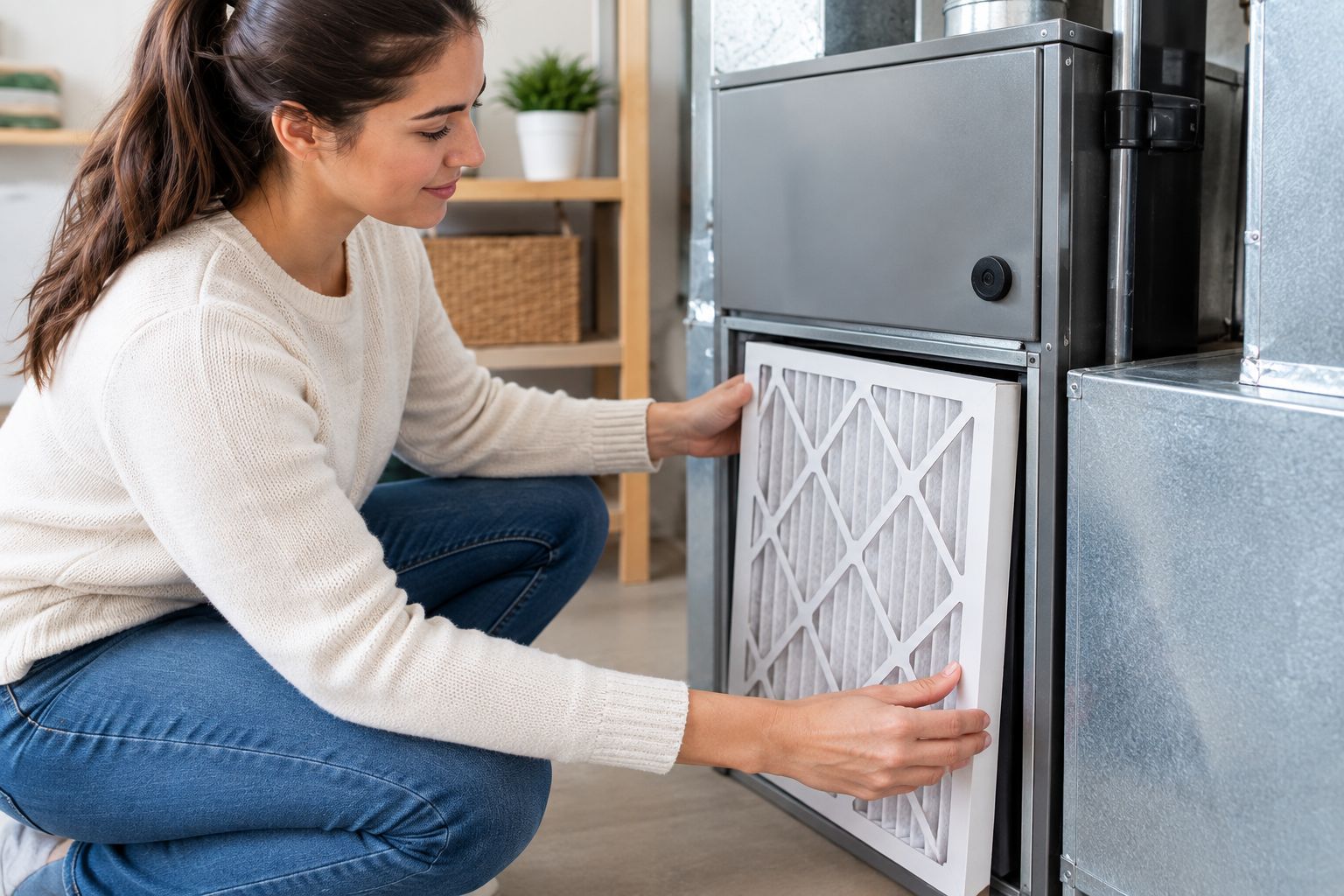
A filter also needs inspection after installation. Follow the replacement guidance for the specific filter and equipment, and replace a loaded filter rather than treating its printed MERV rating as permanent performance. Schwantes Heating's furnace-filter recommendation depends on a filter that both fits and remains usable in the system.
How we ranked the filters
This 2026 ranking puts allergy-focused particle capture first, then applies an equipment-compatibility test. MERV 13 ranks highest because the EPA recommends it when a system can accommodate it. A deep-media MERV 13 filter gets a separate slot because its buyer needs a different cabinet; MERV 11 and MERV 8 follow as progressively lower-rated fallbacks.
The order does not rate specific manufacturers, measure your home's airflow or predict allergy outcomes. Use it to narrow the filter type, then verify the individual product against your equipment. A correctly specified MERV 11 filter is a better choice than a MERV 13 filter your system cannot support.
Which furnace filter should you choose?
Choose a MERV 13 pleated filter in 2026 if it fits your existing slot and meets your HVAC system's airflow requirements. If you already have a compatible media cabinet, choose the MERV 13 format specified for that cabinet instead. Move to MERV 11 when MERV 13 is unsuitable; use MERV 8 only when the system's requirements keep you from the higher-rated options.
The default is deliberately conditional. No filter in this ranking wins when it is the wrong size, the wrong cabinet format or too restrictive for the equipment. Confirm those three points before buying.
FAQ
What are the best furnace filters for allergies in 2026?
MERV 13 pleated filters are the best default for allergies in 2026 when the HVAC system can support them. Choose the exact size and format the equipment requires, and check airflow compatibility.
Is MERV 13 better than MERV 11 for allergies?
MERV 13 has a higher rated level of particle capture than MERV 11. MERV 11 is the better equipment choice when the system cannot accommodate the MERV 13 filter being considered.
Can I put a MERV 13 filter in any furnace?
No. A MERV 13 filter must fit the filter opening and meet the HVAC system’s airflow requirements; fitting into the slot alone is not proof of compatibility.
Is a deep-media filter better than a standard-slot filter?
A deep-media filter is the right format when your system has a compatible media cabinet. Do not substitute it for a standard-slot filter; compare ratings and equipment requirements within the correct format.
Does a furnace filter remove every allergy trigger?
No. A furnace filter captures particles from air that passes through the HVAC system, not every particle in a home. Its rating also does not account for air that bypasses a poorly fitted frame.
When should I replace an allergy furnace filter?
Replace the filter according to its manufacturer’s guidance and your HVAC equipment instructions, and inspect it for loading. Replacement timing depends on the filter and conditions in the home.
Is MERV 8 enough for allergies?
MERV 8 is a basic fallback, not the first choice in this allergy-focused ranking. Use a compatible MERV 11 or MERV 13 filter instead when your system supports one.
One last thing
The MERV number describes a filter, not the air that goes around it. Before changing ratings in 2026, check the frame against the opening: correcting a poor fit matters even when you keep the same filter type. Schwantes Heating's furnace-filter advice starts with that simple check because a rating cannot filter bypass air.
Related guides
- Best furnaces for Minnesota winters
- Best whole-home humidifiers for dry winter air
- Best whole-house dehumidifiers for basements
- Best HVAC maintenance plans compared

