

The best furnace for Minnesota winters in 2026 is a two-stage or fully modulating gas furnace rated at 95% AFUE or higher, sized to run through sustained sub-zero stretches without short-cycling. Carrier's Infinity 98 tops this ranking, with Trane, Lennox, Goodman, and Bryant covering different budgets, home sizes, and cold-snap demands.
- Carrier Infinity 98 is the best furnace for Minnesota winters in 2026, hitting 98.5% AFUE with true modulation.
- Trane S9V2-XC95m wins on extreme cold-snap reliability with variable-capacity heating down to 65% output.
- Goodman GMVC96 is the best budget high-efficiency pick without dropping below 96% AFUE.
- Lennox SLP99V hits 99% AFUE, the highest in this ranking, but only pays off in very tight installs.
- Bryant Evolution 987M is built for large homes running multi-zone heating through a Minnesota winter.
Why this matters
Minnesota furnaces run harder and longer than furnaces almost anywhere else in the Lower 48. Design temperatures across the state sit between -10°F and -25°F, and a furnace sized or staged wrong either short-cycles on mild days or can't keep up when the mercury drops. Schwantes Heating sees the failure pattern every winter: single-stage 80% AFUE units installed for upfront cost, then replaced mid-January when a cold snap outlasts their runtime.
The furnace you pick in 2026 has to do two jobs at once: hold efficiency on a 20°F evening and still deliver full output at -20°F without stalling. That's a staging and modulation question as much as an AFUE question, which is why this ranking weighs both.
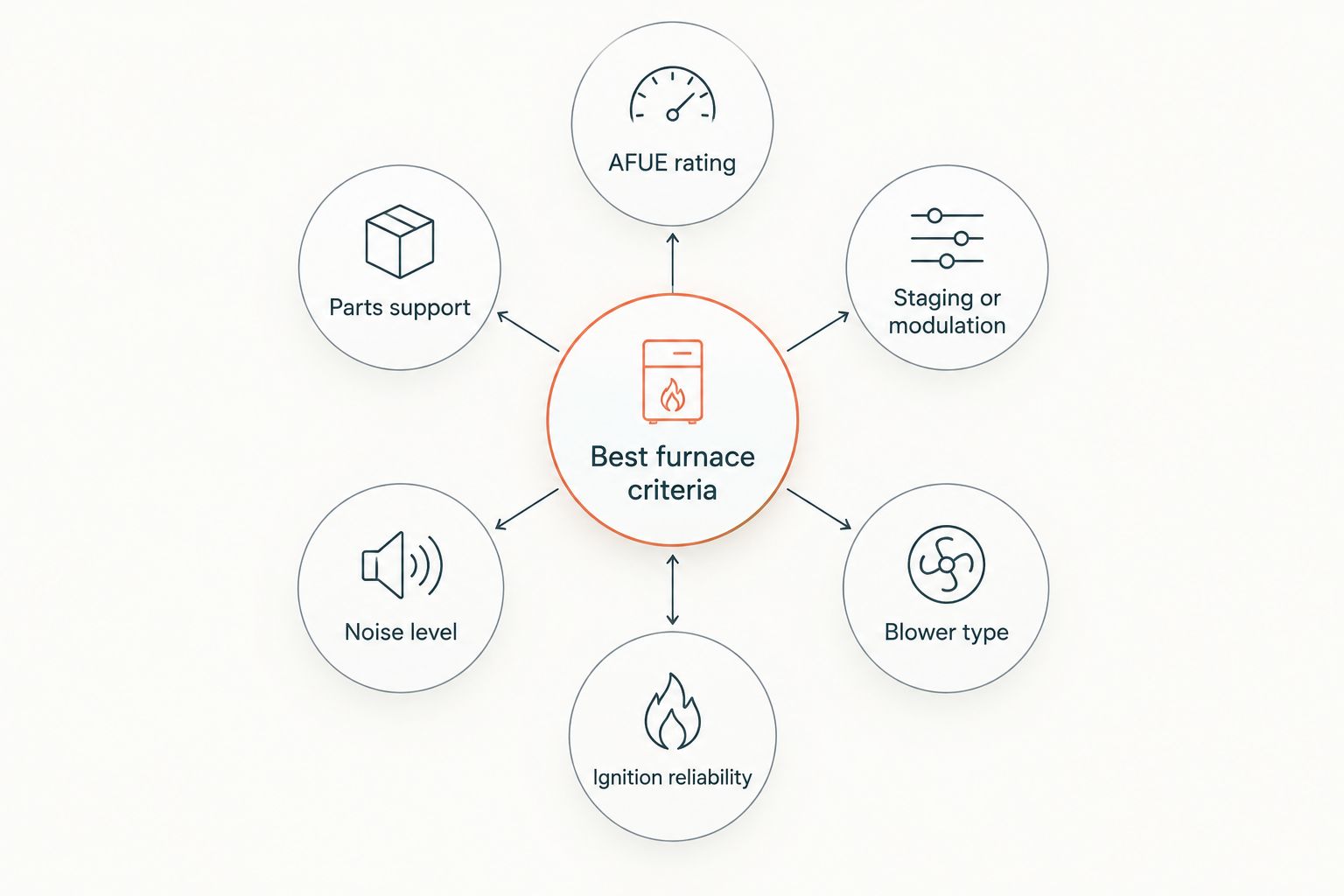
What makes the best furnace for Minnesota winters
- AFUE rating: 95% AFUE or higher for genuine cold-climate performance; anything below trails Minnesota's deep-winter loads.
- Staging or modulation: two-stage or variable-capacity burners hold comfort on mild days and still hit full output below zero.
- Blower type: variable-speed blowers move air more evenly through the long duct runs common in Minnesota basements and ranch homes.
- Cold-start ignition reliability: ignition rated to fire consistently in an unheated garage or exterior mechanical room.
- Noise level: matters most in finished basements where the furnace sits near living space.
- Parts and warranty support: how easily a local contractor can source parts mid-February, not just at install.
Furnaces for Minnesota winters at a glance
| Furnace | Best For | Standout Feature | Key Limitation |
|---|---|---|---|
| Carrier Infinity 98 | Whole-home comfort control | 98.5% AFUE with true modulation | Needs an Infinity communicating thermostat to unlock full range |
| Trane S9V2-XC95m | Extreme cold-snap reliability | Variable-capacity burner down to 65% output | 97% AFUE, a step below the top efficiency tier |
| Goodman GMVC96 | Budget-conscious high efficiency | 96% AFUE with a variable-speed blower | Smaller independent dealer network than Carrier or Trane |
| Lennox SLP99V | Maximum efficiency in tight spaces | 99% AFUE, the highest in this ranking | Full modulation benefit requires Lennox iComfort controls |
| Bryant Evolution 987M | Large homes running zoned heating | 98.3% AFUE with zoning-ready controls | Sold mainly through Carrier-affiliated dealer networks |
1. Carrier Infinity 98: best furnace for whole-home comfort control
The Infinity 98 modulates gas input in small increments rather than snapping between low and high fire, which keeps indoor temperature swings tight even during a Minnesota cold front. Paired with Carrier's Infinity System controls, it adjusts blower speed and gas input together instead of running each component on its own.
Carrier Infinity 98 pros:
- 98.5% AFUE, near the top of any furnace sold in the U.S. in 2026
- True modulation instead of simple two-stage switching
- Sound levels low enough for a furnace installed near a finished basement family room
Carrier Infinity 98 cons:
- Full modulation only works with a matched Infinity thermostat and blower
- Communicating system components cost more to replace than standard parts if something outside the furnace fails
- Overkill for a small, well-insulated home that never needs more than single-stage output
Carrier Infinity 98 best for: homeowners who want the tightest temperature control through a full Minnesota winter and are willing to buy into Carrier's matched system.
Verdict: Buy.
2. Trane S9V2-XC95m: best furnace for extreme cold-snap reliability
Trane built the XC95m around variable-capacity heating that ramps between 65% and 100% output rather than a fixed low stage, which matters when a Minnesota cold snap pushes past -20°F for several days straight. The furnace holds output up rather than cycling off and restarting, which is where cheaper two-stage units struggle most.
Trane S9V2-XC95m pros:
- Variable-capacity burner keeps heating output up during sustained cold rather than cycling
- Comfort-oriented airflow control reduces temperature swings between rooms
- Strong track record among Minnesota installers for cold-climate performance
Trane S9V2-XC95m cons:
- 97% AFUE, a notch below the Infinity 98 and the SLP99V
- Variable-capacity range starts at 65%, less low-end turndown than a fully modulating unit
- Premium tier positioning puts it above single-stage or basic two-stage options
Trane S9V2-XC95m best for: homes in the coldest pockets of Minnesota – Duluth, International Falls, the Iron Range – where multi-day sub-zero stretches are routine.
Verdict: Buy.
3. Goodman GMVC96: best budget high-efficiency furnace
Goodman's GMVC96 delivers 96% AFUE and a variable-speed blower without the communicating-system premium that Carrier, Trane, and Lennox build into their top tiers. It runs as a straightforward high-efficiency furnace that any licensed HVAC contractor can service, not just a dealer certified on a proprietary control system.
Goodman GMVC96 pros:
- 96% AFUE clears the cold-climate efficiency bar without the top-tier premium
- Variable-speed blower smooths airflow through long basement duct runs
- Standard components mean more contractors nationwide can service it
Goodman GMVC96 cons:
- No true modulation, so output steps rather than ramps smoothly like the Infinity 98
- Smaller independent parts and dealer network than the big three brands above
- Resale perception among some buyers lags Carrier, Trane, and Lennox despite similar core performance
Goodman GMVC96 best for: homeowners who want 95%+ AFUE and a variable-speed blower without paying for a fully modulating, communicating system.
Verdict: Buy.
4. Lennox SLP99V: best furnace for maximum efficiency in tight installs
The SLP99V posts a 99% AFUE rating, the highest of any furnace in this ranking, and Lennox built its cabinet to fit smaller mechanical closets than a comparable Carrier or Trane unit. Precise Comfort variable-capacity heating adjusts output in fine steps similar to the Infinity 98's approach.
Lennox SLP99V pros:
- 99% AFUE, the top efficiency number on this list
- Compact cabinet fits tighter utility closets than most 95%+ AFUE furnaces
- Precise Comfort modulation smooths temperature swings room to room
Lennox SLP99V cons:
- Full modulation benefit only shows up with Lennox's iComfort thermostat installed alongside it
- Marginal efficiency gain over the Infinity 98 or Evolution 987M rarely changes the fuel bill enough to matter
- Complex control board raises the cost of a non-warranty repair down the line
Lennox SLP99V best for: a retrofit where the mechanical closet is small and every AFUE point matters on paper.
Verdict: Hold – the 99% AFUE number looks great on a spec sheet, but most Minnesota homes won't see a meaningful fuel-bill difference over a 98% unit; hold off unless the tight cabinet size is the actual constraint.
5. Bryant Evolution 987M: best furnace for large homes running zoned heating
The Evolution 987M pairs 98.3% AFUE with zoning-ready controls built for homes running two or three heating zones off one furnace. Bryant shares engineering with Carrier, so the 987M's modulation and blower control behave similarly to the Infinity 98 under a different badge.
Bryant Evolution 987M pros:
- 98.3% AFUE with zoning controls built in rather than bolted on
- Handles multiple heating zones without a separate zone control board in most setups
- Shares parts commonality with Carrier, which widens the service network in Minnesota
Bryant Evolution 987M cons:
- Sold mainly through Carrier-affiliated dealer networks, which limits shopping around on install
- Zoning benefit is wasted on a single-zone home
- Full modulation still ties to a matched communicating thermostat, same limitation as the Infinity 98
Bryant Evolution 987M best for: larger Minnesota homes – two stories plus a finished basement – running separate heating zones.
Verdict: Buy.
How this ranking works
Every furnace above clears the 95% AFUE line this ranking treats as the floor for Minnesota winters. From there, the split comes down to staging: full modulation (Carrier, Lennox, Bryant) against variable-capacity two-stage (Trane) against Goodman's simpler two-stage-plus-variable-blower approach. Noise, dealer network depth, and control-system lock-in decided the "best for" label on each one, not just the AFUE number on the spec sheet.
Get a furnace sized for your home
Schwantes Heating checks AFUE, staging, and load calculation before you buy.
Which furnace should you choose?
Buy the Carrier Infinity 98 if you want the tightest comfort control and don't mind buying into a matched communicating system. Buy the Trane S9V2-XC95m if you live somewhere sub-zero stretches run multiple days, not hours. Buy the Goodman GMVC96 if 95%+ AFUE matters more than a modulating control system and you want a lower-tier entry point. Hold on the Lennox SLP99V unless a tight mechanical closet is a real constraint – the extra AFUE point over the Infinity 98 rarely shows up on the gas bill. Buy the Bryant Evolution 987M if the home runs multiple heating zones and a single Carrier-family furnace can cover all of them.
For most Minnesota homes in 2026, the Carrier Infinity 98 or the Trane S9V2-XC95m covers the majority of use cases – modulation for comfort, variable capacity for cold-snap reliability. Goodman's GMVC96 is the right call when the budget line matters more than the control system.
FAQ
What is the best furnace for Minnesota winters in 2026?
The Carrier Infinity 98 ranks best overall for Minnesota winters in 2026, with 98.5% AFUE and true modulation. The right pick still depends on home size and how cold your specific part of Minnesota runs.
What AFUE rating do you need for a Minnesota furnace?
95% AFUE or higher is the practical floor for a Minnesota furnace. Every furnace in this ranking sits between 96% and 99% AFUE.
Is a two-stage furnace worth it in Minnesota?
Yes, a two-stage or variable-capacity furnace is worth it in Minnesota because it holds output through multi-day cold snaps instead of cycling on and off like a single-stage unit. Single-stage furnaces still work but run less efficiently on the mild days that make up most of the heating season.
How cold can a modern gas furnace run reliably?
A properly sized 95%+ AFUE furnace with cold-rated ignition runs reliably through Minnesota design temperatures of -10°F to -25°F. Reliability at those temperatures depends more on correct sizing and installation than on the brand.
Should I buy a modulating furnace or a two-stage furnace for Minnesota?
Buy a modulating furnace like the Carrier Infinity 98 or Lennox SLP99V for the tightest comfort control, and a variable-capacity two-stage furnace like the Trane S9V2-XC95m if cold-snap output matters more than fine temperature control. Both outperform a fixed single-stage furnace through a Minnesota winter.
Is Goodman a good furnace brand for cold climates?
Goodman’s GMVC96 clears the 95%+ AFUE bar cold climates need and adds a variable-speed blower, making it a legitimate cold-climate option. Its dealer and parts network is smaller than Carrier, Trane, or Lennox, which matters more for long-term service than for one winter’s performance.
What size furnace do I need for a Minnesota home?
Furnace sizing in Minnesota runs on a Manual J load calculation, not square footage alone, though a rough cold-climate rule of thumb lands around 40 to 60 BTU per square foot before adjusting for insulation and window count. An oversized furnace short-cycles; an undersized one can’t keep up at -20°F.
How often should a Minnesota furnace be serviced?
Once a year, ideally in early fall before the heating season starts. A furnace running through a Minnesota winter logs far more run-hours than one in a milder climate, which makes annual service more important, not less.
One last thing
The AFUE number on the spec sheet assumes a lab test, not a Minnesota basement with a long duct run and a leaky return. A 98% AFUE furnace installed with an undersized return or poor duct sealing can perform closer to a 90% unit in real conditions. The efficiency gap between the Goodman GMVC96 and the Lennox SLP99V – three AFUE points – matters less in 2026 than whether the installer sized the ductwork and combustion air correctly on install day.

