

Best overall: a modulating gas furnace with a variable-speed blower. Best for balancing comfort and equipment complexity: a two-stage gas furnace with a variable-speed blower. Best for simpler equipment: a single-stage gas furnace with a variable-speed blower. Schwantes Heating’s best variable speed furnace pick for steady heat in a gas-heated home is the modulating configuration. This 2026 guide ranks furnace configurations rather than unverified model claims, so you can compare the features that matter before choosing equipment.
- Best variable speed furnace for steady heat in 2026: a modulating gas furnace with a variable-speed blower.
- Choose two-stage gas for a balance of steadier heat and a less complex burner.
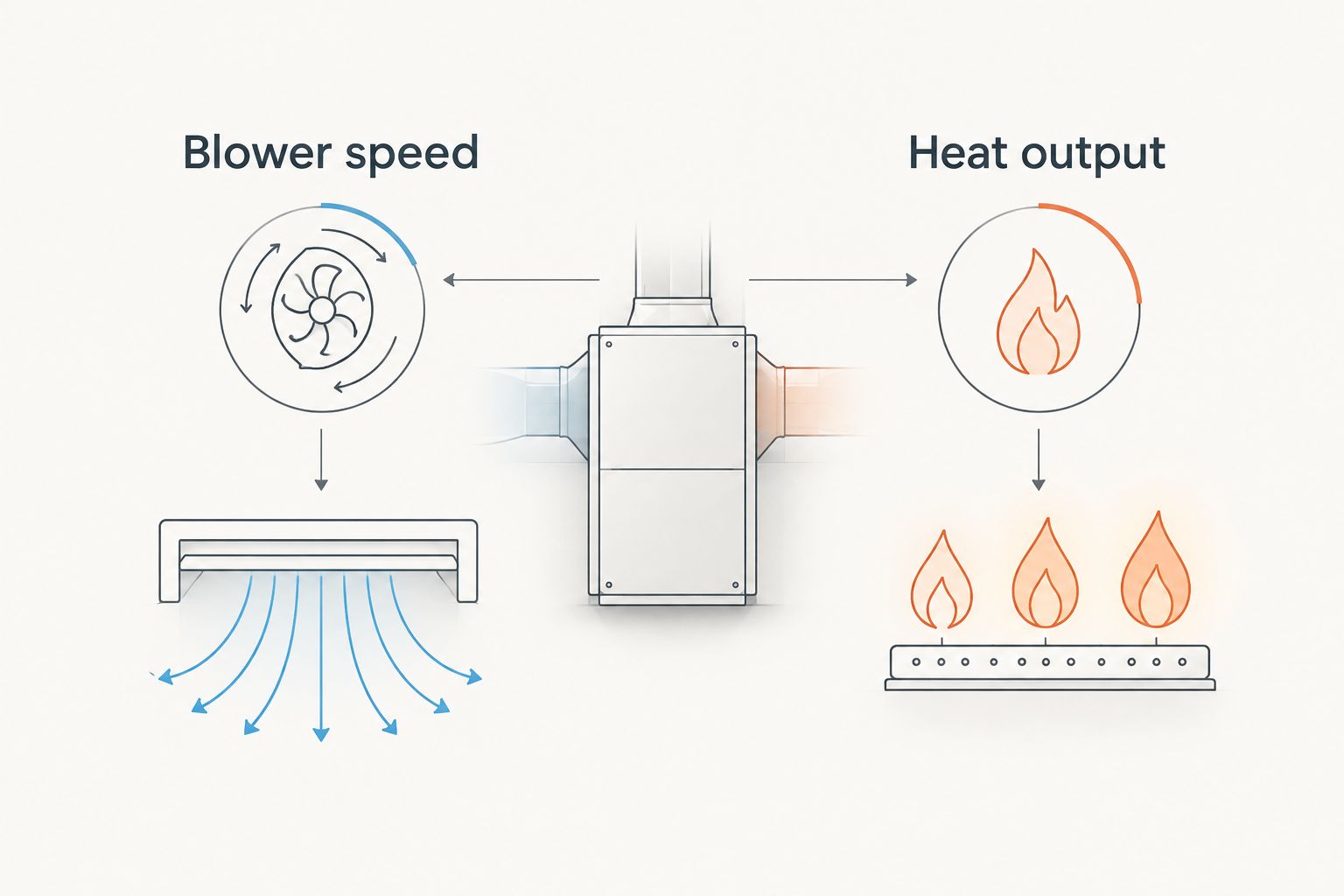
- A variable-speed blower controls airflow; it does not automatically make burner output variable.
- Check heat-loss sizing, ductwork and thermostat compatibility before selecting a furnace.
Why this matters
A variable-speed furnace moves air at different blower speeds. That does not tell you how many heating outputs its burner has. A single-stage furnace can have a variable-speed blower and still produce heat at only one burner setting. If your goal is steadier room temperature, compare burner operation as well as blower operation.
Use Schwantes Heating as the starting point for the related heating guides linked below. For this 2026 ranking, the decision is about system design: fuel source, heat output, airflow, efficiency and whether the rest of your heating system can use the furnace’s controls.
What makes the best variable speed furnace
- Blower speed: A variable-speed blower adjusts airflow instead of relying on one fixed operating speed. Ask what airflow settings the proposed system uses during heating, cooling and continuous fan operation.
- Heat output: Modulating burners adjust heat output across a range; two-stage burners use lower and higher settings; single-stage burners have one heating setting. More output choices give the furnace more ways to match changing demand, but only when the controls support them.
- Heat-loss sizing: A furnace needs to fit your home’s calculated heating load. Oversizing can cause frequent cycling, while undersizing can leave the house short of heat during design conditions. Request a room-by-room or whole-home load calculation, not a replacement chosen solely from the old furnace’s nameplate.
- Duct compatibility: The blower has to move the required air through your existing ducts, filter and registers. Restrictive ductwork does not become adequate because the motor can vary its speed; ask for a static-pressure check.
- Efficiency and venting: Annual fuel utilization efficiency, or AFUE, measures how much fuel becomes useful heat over a standardized heating season. An 80% AFUE rating and a 95% AFUE rating describe different fuel efficiency, not different blower performance. Changing to a higher-efficiency gas furnace can also change venting and condensate requirements.
- Control compatibility: Confirm that the thermostat and any paired cooling or heat-pump equipment support the proposed furnace’s operating stages. A capable furnace connected to unsuitable controls will not deliver the operation described in a brochure.
Blower speed and heat output are separate buying decisions. In 2026, reject any comparison that calls a furnace fully variable simply because its blower speed changes. Schwantes Heating’s variable-speed furnace ranking puts heat-output behavior beside airflow for that reason.
Best variable-speed furnaces at a glance
These are configuration rankings, not claims that every manufacturer offers identical controls. Confirm the exact equipment combination before you sign an installation proposal.
| Furnace configuration | Best for | Standout feature | Key limitation |
|---|---|---|---|
| Modulating gas with variable-speed blower | Steady heat in a gas-heated home | Adjusts both heat output and airflow | More controls and compatibility checks |
| Two-stage gas with variable-speed blower | Balanced comfort and simpler burner operation | Lower and higher heat settings | Cannot adjust heat output continuously |
| Dual-fuel system with variable-speed gas furnace | Homes using a compatible heat pump | Switches between heat pump and gas heat | Requires coordinated system controls |
| Single-stage gas with variable-speed blower | Simpler heating equipment with airflow control | Variable airflow with one burner setting | Full heat output whenever heating |
| Electric furnace with variable-speed blower | Homes using electric resistance heat | Variable airflow without a gas burner | Resistance heat can increase electricity use |
1. Modulating gas: best variable-speed furnace for steady heat
Best for: A gas-heated home where steadier delivered heat matters more than choosing the simplest burner. A modulating gas furnace adjusts burner output across its supported operating range. Its variable-speed blower changes airflow to work with that output, giving the system more ways to meet a changing heating load than a single-stage burner provides.
That makes this the best overall 2026 configuration for a homeowner shopping specifically for variable-speed comfort. It is not a promise that any modulating furnace will fix cold rooms. Duct restrictions, sizing and controls still determine what happens after installation.
Modulating gas pros:
- Adjusts heat output rather than merely changing fan speed.
- Can operate at lower output when the home needs less heat.
- Pairs variable airflow with variable burner operation.
Modulating gas cons:
- Requires careful checks of thermostat and control compatibility.
- Adds burner-control complexity compared with a single-stage furnace.
- Cannot correct an inadequate duct layout on its own.
Ask the installer to identify the exact compatible thermostat and explain how the furnace will control both heating output and airflow. Also ask for a heat-loss calculation and measured or planned airflow checks. A claimed modulation feature is useful only if the installed system can operate it correctly.
Verdict: Buy if your home uses gas heat and your priority is steadier heating. Hold if the proposal omits load sizing or control details.
2. Two-stage gas: best for balanced comfort
Best for: A gas-heated home whose owner wants more heat-output flexibility without a modulating burner. A two-stage gas furnace runs at a lower or higher heating setting. With a variable-speed blower, it can adjust airflow while the burner changes between those settings.
This is the practical middle choice in 2026. The lower setting gives the system a way to supply less heat when full output is unnecessary. Unlike a modulating burner, however, it cannot continuously adjust its heat output across a range.
Two-stage gas pros:
- Offers a lower heating setting as well as full output.
- Combines staged heat with adjustable blower airflow.
- Gives you a clear alternative to both modulating and single-stage operation.
Two-stage gas cons:
- Has fewer heat-output settings than a modulating furnace.
- Depends on compatible controls to use its stages as intended.
- Still needs correct sizing and adequate ducts.
Ask how the thermostat calls for each stage and how airflow changes with it. If a proposal emphasizes the variable-speed motor but does not explain stage control, you do not yet have enough information to compare it with the top pick.
Verdict: Buy when you want staged gas heat and variable airflow without making continuous modulation the deciding feature.
3. Dual fuel: best for homes pairing gas with a heat pump
Best for: A home with, or planning, a compatible heat pump alongside a gas furnace. In a dual-fuel arrangement, the heat pump supplies heating under selected conditions and the furnace supplies gas heat when the system calls for it. A variable-speed furnace blower must work with both sides of that system.
This 2026 pick is about system fit, not a claim that dual fuel beats a gas-only furnace in every home. The heat pump, furnace and controls need a defined changeover strategy. Compare the complete equipment pairing; a variable-speed label on the furnace tells you little about how the heat pump will operate.
Dual-fuel pros:
- Lets a compatible heat pump and gas furnace share the heating job.
- Makes use of a variable-speed blower across the paired system when properly configured.
- Gives households already considering a heat pump a relevant furnace choice.
Dual-fuel cons:
- Requires compatibility checks across more than one piece of equipment.
- Needs controls set for the intended heat-pump-to-furnace changeover.
- Is unnecessary if you are not pairing the furnace with a heat pump.
Request the proposed furnace and heat-pump model numbers, a compatibility explanation and a written account of when the system switches heating sources. Do not select the furnace separately and assume a later heat-pump pairing will work.
Verdict: Buy for a planned, compatible dual-fuel installation. Hold until the full system and changeover controls are specified.
4. Single-stage gas: best for simpler heating equipment
Best for: A gas-heated home whose owner wants variable blower airflow but does not need staged burner output. A single-stage gas furnace produces heat at its one burner setting whenever it fires. The variable-speed blower can still change airflow for supported operating modes.
This is the simplest gas-burner option in the 2026 ranking, not a substitute for modulating heat. If a seller describes it as variable-speed, ask whether that label applies only to the blower. The answer changes what you should expect from the heating cycle.
Single-stage gas pros:
- Gives you variable blower airflow without a staged burner.
- Makes burner operation straightforward to understand.
- Fits a buyer who values airflow control more than variable heat output.
Single-stage gas cons:
- Delivers its single heat-output setting whenever the burner operates.
- Cannot use a lower burner stage to match lighter heating demand.
- Is especially dependent on sound sizing to avoid unnecessary cycling.
Compare the heat-load calculation with the proposed furnace output. Then ask which fan settings the installation will actually use. If you primarily want steadier heat delivery, move this configuration below two-stage and modulating gas.
Verdict: Hold unless variable airflow, rather than variable heating output, is your main requirement.
5. Electric furnace: best for electric resistance heating
Best for: A home using electric resistance heat where a gas furnace is not part of the plan. An electric furnace heats air with electrical resistance elements; a variable-speed blower distributes that air. Depending on the equipment and controls, heating elements can also operate in stages, but blower speed alone does not establish how those elements are controlled.
Electric resistance converts electricity to heat at the point of use, yet that fact does not establish your operating bill. Electricity use depends on the home’s heating load and system operation. In 2026, compare this choice with other heating-system designs before treating a variable-speed motor as an efficiency verdict.
Electric furnace pros:
- Does not require a gas burner or gas vent.
- Provides variable airflow when the selected blower and controls support it.
- Fits homes already committed to electric resistance heating.
Electric furnace cons:
- Variable blower speed does not remove the electricity demand of resistance heating.
- Element staging varies by equipment and must be confirmed.
- Is not a direct answer for a homeowner specifically replacing a gas furnace.
Ask for the home’s heat-loss calculation and the proposed element-control sequence. If you are open to a heat pump, compare that system design separately rather than assuming the electric furnace is the only electric option.
Verdict: Wait until the electric heating plan and its controls are clear; skip it as a like-for-like gas furnace recommendation.
How we ranked these configurations
The ranking weighs heat-output control first, then blower operation, installation compatibility and the use case each configuration serves. A modulating gas furnace leads for steady gas heat because it adjusts the burner as well as the blower. Two-stage gas follows because it adds a lower heating setting without continuous modulation. Dual fuel ranks separately for homes pairing a furnace with a heat pump; it is not a default replacement for every gas system.
These are 2026 configuration verdicts, not performance claims for unnamed products. Before comparing specific models, get the load calculation, duct assessment, efficiency rating, venting requirements and control plan for your home. Schwantes Heating’s best variable speed furnace recommendation remains conditional on those installation checks: no equipment label overrides a poor system match.
Which variable-speed furnace should you choose?
Choose a modulating gas furnace with a variable-speed blower if you have gas heat and want the strongest match between changing heat demand and furnace output. Choose two-stage gas if you want a lower heating setting but do not need continuous modulation. Choose a dual-fuel pairing only when a compatible heat pump is part of the plan.
Choose single-stage gas only when adjustable airflow matters more to you than adjustable burner output. Consider an electric furnace in the context of an electric heating plan, not as the default answer to a gas-furnace search. For every choice, make the installer show how the proposed furnace, thermostat and ducts work together before deciding.
FAQ
What is the best variable speed furnace in 2026?
A modulating gas furnace with a variable-speed blower is the best overall configuration for steady heat in a gas-heated home. Verify heat-loss sizing, duct capacity and compatible controls before choosing a model.
Does variable speed mean the furnace has variable heat output?
No. Variable speed usually describes the blower, while heat output depends on whether the burner is single-stage, two-stage or modulating. Check both specifications on the proposed equipment.
Is a two-stage furnace better than a single-stage variable-speed furnace?
A two-stage furnace offers more heat-output flexibility than a single-stage furnace when both have variable-speed blowers. The right installation still depends on sizing, ducts and controls.
Does a variable-speed blower increase a furnace’s AFUE?
Blower speed and AFUE measure different things. AFUE describes seasonal fuel-to-heat efficiency; compare the published AFUE rating of each proposed gas furnace separately.
Do I need a special thermostat for a modulating furnace?
You need controls compatible with the specific modulating furnace and its intended operation. Ask the installer to identify the exact thermostat and explain how it commands heat output.
Can a variable-speed furnace fix uneven temperatures between rooms?
A variable-speed furnace cannot by itself fix poorly sized ducts or unbalanced airflow. Request a duct and airflow assessment before treating a furnace replacement as the solution.
Should I choose an electric variable-speed furnace instead of gas?
Choose an electric furnace only as part of a suitable electric heating plan. Its variable-speed blower does not eliminate the electricity demand of resistance heating.
One last thing
Before you compare furnace brochures, ask this: Which feature changes heat output, and which feature changes airflow? A proposal that answers only the airflow question has not established that you need its recommended furnace. That distinction is the fastest way to separate a useful 2026 variable-speed recommendation from a motor specification dressed up as a comfort verdict.
Related guides
- Best furnaces for Minnesota winters
- Best smart thermostats for cold climates
- HVAC brands ranked by energy efficiency
- Best furnace filters for allergies

