

Best overall for a new ducted system: Trane, provided a qualified installer sizes it correctly and can service the selected model. Best for an existing furnace-and-AC setup: Carrier. Best for rooms without ducts: Mitsubishi Electric. Best for a like-for-like ducted replacement: Goodman. These are buying-path recommendations, not a measured ranking of brand failure rates: no model-level repair data is provided for a defensible reliability league table in 2026.
- Most reliable HVAC brands ranked for 2026: Trane fits new ducted systems; Mitsubishi Electric fits ductless rooms.
- Carrier fits an existing furnace-and-AC setup; Goodman fits a straightforward ducted replacement.
- No brand name substitutes for correct sizing, installation quality and local service support.
- Compare the exact model and written installation scope before choosing an HVAC brand.
Why this matters
A brand ranking can narrow your search, but the name on the cabinet does not tell you whether a system fits your house. Duct condition, equipment sizing, installation and access to service all affect the ownership experience. If you are comparing complete systems rather than brand reliability, HVAC systems ranked by price addresses a different decision; this 2026 guide concentrates on fit and repair readiness, without assuming that a higher-cost choice lasts longer.
Schwantes Heating's HVAC reliability verdict is conditional: choose the brand only after a contractor identifies the exact equipment, explains the installation scope and confirms who will service it. A claim that one brand fails less often than another needs comparable repair records, model definitions and observation periods. Those figures are not available here, so the order below is a decision tree, not a failure-rate study.
What makes the best HVAC brand for your home?
Use these criteria before reading the 2026 ranking. A familiar brand is useful only if its equipment and the proposed installation answer the same questions.
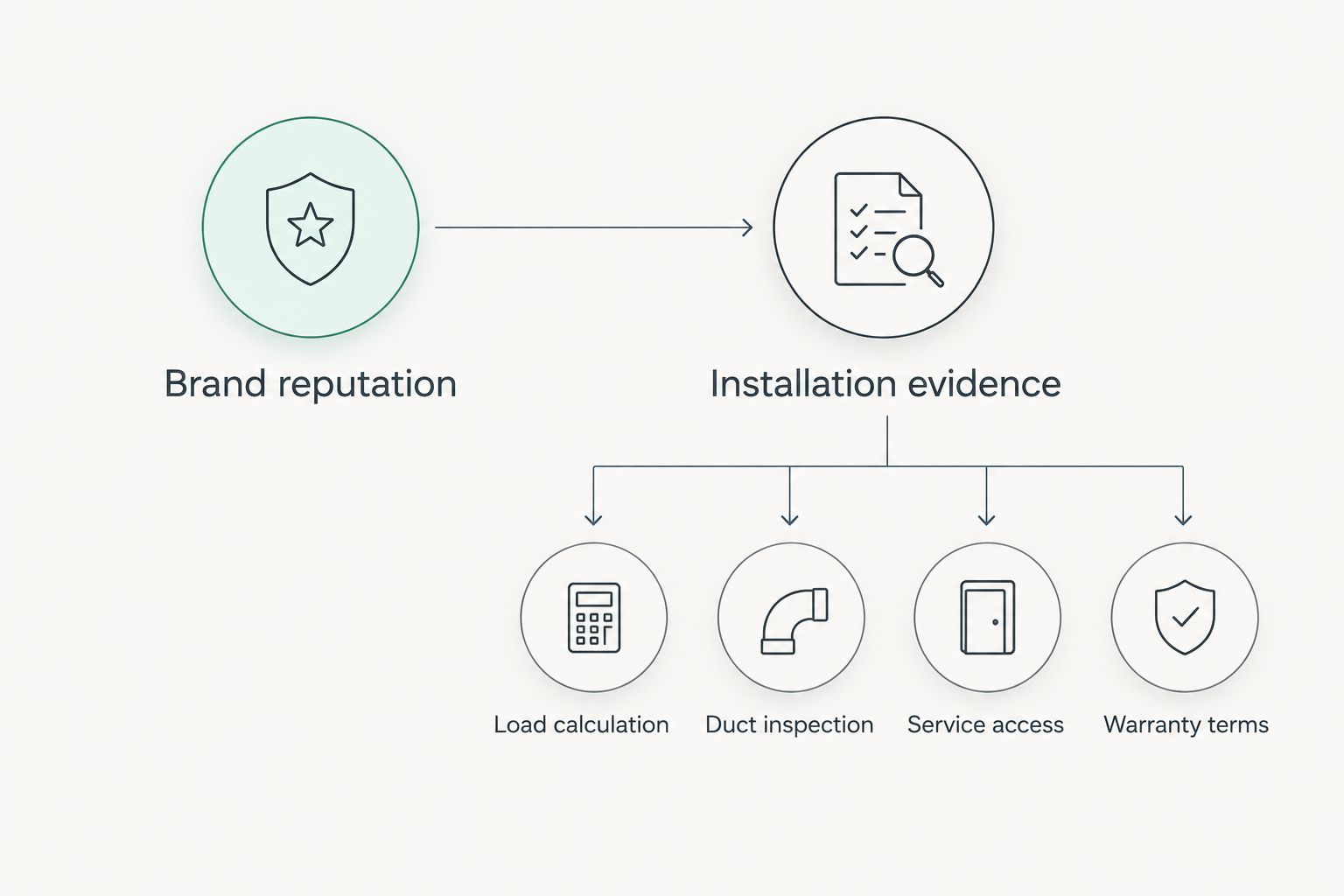
- Load calculation: Ask how the contractor determined the heating and cooling capacity your home needs. Square footage alone does not describe insulation, windows or air leakage.
- Duct inspection: For a ducted system, ask whether existing ducts can deliver the required airflow and whether leaks or restrictions need attention. A new unit does not repair defective ductwork.
- Service access: Identify who will diagnose the specific model after installation. Ask how replacement parts and technical support are handled locally rather than assuming national brand recognition settles the issue.
- Installation scope: Get the proposed indoor and outdoor equipment, controls and required changes in writing. Compare complete scopes, not cabinet labels.
- Warranty terms: Read the written coverage and registration requirements for the exact model. Equipment coverage and labor coverage are different questions.
- Maintenance fit: Choose a system whose filters and service points you can access and whose upkeep you will actually perform.
Capacity illustrates why a logo cannot replace a load calculation: 1 ton of cooling equals 12,000 BTU per hour. A 2-ton system is rated at 24,000 BTU per hour; a 3-ton system is rated at 36,000 BTU per hour. Those numbers describe cooling capacity, not reliability or the size your house requires. Oversizing is not a reliability strategy.
Brand reputation versus installation evidence
Brand reputation gives you a starting shortlist. Installation evidence tells you whether a particular proposal belongs on it: a documented load calculation, an inspection of the distribution system, an identified equipment combination and a clear service contact. In 2026, ask for these items from every bidder before treating a brand ranking as a buying decision.
Most reliable HVAC brands ranked at a glance
This table ranks which buying situation each brand fits, not independently verified failure rates. No starting-price column appears because no current, comparable price data is supplied. Request a written quote for the complete installation instead.
| Brand | Best for | Standout fit | Key limitation |
|---|---|---|---|
| Trane | New ducted installation | Heating and cooling equipment for a planned ducted system | The brand cannot correct poor sizing or duct design |
| Carrier | Existing furnace-and-AC setup | A familiar ducted heating-and-cooling choice | Existing airflow problems remain unless the scope fixes them |
| Mitsubishi Electric | Rooms without ducts | Ductless heating and cooling | Indoor units and their filters need room-by-room planning |
| Goodman | Like-for-like ducted replacement | Conventional ducted equipment | A simple swap is unsuitable when the original system was mis-sized |
1. Trane: best HVAC brand for a new ducted installation
Trane makes central heating and cooling equipment. It is the first brand to consider when you are planning a new ducted system and can compare a complete installation proposal rather than replacing equipment by name alone. Trane is the default pick for a new ducted HVAC installation in this 2026 guide, not a proven winner on failure rate.
A new installation gives the contractor a chance to specify the heating and cooling equipment, controls and duct design together. That opportunity matters more than repeating an old equipment size. Ask for the exact models and the work included; then check whether local technicians will service that combination.
Trane pros:
- Offers central heating and cooling equipment for a ducted plan.
- Lets you evaluate the equipment alongside a new distribution design.
- Fits a quote that documents the whole installation rather than a cabinet-only swap.
Trane cons:
- Brand reputation does not establish the reliability of the proposed model.
- Correct equipment cannot compensate for undersized or poorly installed ducts.
- Local service arrangements still need confirmation.
Trane pricing: Request a written quote for the specified equipment and installation; a brand-wide figure would not describe your job.
Best for: A homeowner commissioning a new ducted heating-and-cooling system.
Verdict: Buy when the Trane proposal includes sizing, duct design and a clear service plan. Hold if it relies on the brand name instead of that work.
2. Carrier: best HVAC brand for an existing furnace-and-AC setup
Carrier supplies ducted heating and air-conditioning equipment. It belongs on the shortlist when your home already has a furnace-and-AC arrangement and you want bids that address both sides of the system. The test is whether the proposed equipment works with your home's actual ducts and controls, not whether the replacement resembles the old units.
Ask each bidder what will remain, what will change and how airflow was assessed. If the home has uneven temperatures, replacing the equipment without investigating distribution leaves an obvious question unanswered. A 2026 reliability decision should account for that unresolved work before you sign.
Carrier pros:
- Provides an option for a ducted heating-and-cooling comparison.
- Fits a review of the furnace and AC as a connected system.
- Gives you a basis for comparing complete replacement scopes.
Carrier cons:
- The brand does not fix existing airflow restrictions by itself.
- A proposal can omit needed duct or control work regardless of equipment choice.
- Brand-level reputation does not supply model-level failure evidence.
Carrier pricing: Compare written quotes for the same scope; do not treat equipment-only figures as installed-system comparisons.
Best for: A homeowner replacing an existing ducted furnace-and-AC setup.
Verdict: Buy if the Carrier bid addresses the existing distribution system and specifies the equipment and service arrangement. Hold if it ignores known comfort problems.
3. Mitsubishi Electric: best HVAC brand for rooms without ducts
Mitsubishi Electric offers ductless heating and cooling systems. It is the clearest fit in this ranking when the space lacks ducts and adding conventional ductwork is not the plan. Ductless equipment changes the comparison: you must decide where indoor units go, which rooms they serve and how you will access their filters.
Do not compare a ductless proposal with a central-system quote as if both condition the same spaces in the same way. Ask for a room-by-room plan showing the intended coverage and equipment locations. Also confirm who will service the exact system locally; a strong ductless concept is not a substitute for an executable installation plan.
Mitsubishi Electric pros:
- Offers heating and cooling without a conventional duct network.
- Supports a room-by-room equipment discussion.
- Makes indoor-unit location part of the proposal rather than an afterthought.
Mitsubishi Electric cons:
- Each proposed indoor-unit location needs review for placement and access.
- Filter upkeep must account for the installed indoor units.
- Brand selection alone does not prove suitable room coverage or local service support.
Mitsubishi Electric pricing: Request a quote tied to the proposed room coverage and installation scope.
Best for: A homeowner conditioning rooms that do not have ducts.
Verdict: Buy when the Mitsubishi Electric proposal maps the rooms, indoor units and service plan. Hold if coverage is described only as an equipment name.
4. Goodman: best HVAC brand for a like-for-like ducted replacement
Goodman makes conventional ducted heating and cooling equipment. Consider it when an existing ducted system is being replaced and the contractor has verified that the present layout and required capacity still make sense. Like-for-like describes the work, not permission to copy an old unit's size without checking it.
This slot is narrower than Trane's new-installation slot or Carrier's broader furnace-and-AC review. If rooms already heat or cool unevenly, a straightforward swap does not answer why. Ask the bidder to document the load, inspect airflow and state any changes needed before treating replacement as simple.
Goodman pros:
- Supplies equipment for a conventional ducted replacement.
- Fits a proposal with a clearly defined removal-and-replacement scope.
- Allows a direct check of which existing components the contractor intends to retain.
Goodman cons:
- Repeating the old system's size can repeat an old sizing error.
- A narrow replacement scope will not correct defective ductwork.
- The exact model and local service arrangement still need review.
Goodman pricing: Obtain a written installed quote that identifies retained equipment and any required changes.
Best for: A homeowner whose existing ducted layout has been checked and who needs a defined replacement scope.
Verdict: Buy when the Goodman bid documents that the existing system is suitable for a direct replacement. Hold when the contractor has not checked sizing and airflow.
How we ranked the 2026 choices
The order prioritizes the decisions a homeowner can verify: system type, installation scope, sizing, ducts and service access. Trane leads the new-ducted path; Carrier addresses an existing furnace-and-AC setup; Mitsubishi Electric fills the ductless path; Goodman fits a verified like-for-like replacement. Each brand occupies a different job, so the table is not a claim that the first brand fails less often than the fourth.
A genuine failure-rate ranking would need comparable records for specific models, a defined observation period and a consistent way to count repairs. This guide has none of those measurements. Do not let an unsourced reliability percentage decide your purchase. Ask for the exact model and a written explanation of why it fits your house.
Check your HVAC options
Start with the home site, then compare written installation scopes for the equipment you are considering.
Which HVAC brand should you choose?
For a new ducted installation, start with Trane and require a proposal that documents sizing and duct design. For an existing furnace-and-AC setup, compare a Carrier proposal against the condition of the current ducts and controls. Choose Mitsubishi Electric as the ductless candidate when the rooms have no ducts; consider Goodman for a like-for-like replacement only after the old system's sizing and airflow have been checked.
If you are undecided, buy the best-documented installation proposal, not the highest-ranked logo. A 2026 quote should name the equipment, explain its capacity, identify what happens to the ducts or indoor units, and tell you who handles service. When two bids omit different pieces of that work, they are not equivalent reliability choices.
FAQ
What are the most reliable HVAC brands ranked for 2026?
No verified brand failure-rate ranking is established by the information in this guide. For buying fit, start with Trane for a new ducted system, Carrier for an existing furnace-and-AC setup, Mitsubishi Electric for ductless rooms and Goodman for a checked like-for-like replacement.
Is Trane more reliable than Carrier?
This guide does not establish that Trane fails less often than Carrier. Compare the exact models, installation scopes, duct assessments and local service arrangements before choosing.
Is Mitsubishi Electric better than a central HVAC system?
Mitsubishi Electric is the ductless pick for rooms without ducts, not a universal replacement for central HVAC. Compare which rooms each proposal conditions and where the indoor equipment will go.
Does HVAC installation affect reliability?
Yes: sizing, airflow and installation determine whether the selected equipment operates as intended. Ask for a load calculation, a duct or room-coverage plan and a written scope.
Should I replace my HVAC system with the same size?
Not without checking the home’s load and the existing system’s performance. Cooling capacity is measured in BTU per hour, and an old unit’s nameplate does not prove that its size was correct.
What should I ask about HVAC service before buying?
Ask who will service the exact model, how replacement parts are handled locally and what the written warranty covers. Get those answers for each proposal rather than assuming all equipment under one brand has the same support.
One last thing
The least useful question in a 2026 HVAC comparison is which logo wins without any description of the house. The more useful question is: What work in this proposal makes this exact system suitable for my home? Schwantes Heating's HVAC brand shortlist gives you candidates; the written answer to that question gives you a way to choose among them.
Related guides
- Best HVAC maintenance plans compared
- Best furnaces for Minnesota winters
- HVAC brands ranked by energy efficiency

